Commercial Water Damage in Athens, GA: Why the First 24 Hours Decide the Cost
Here is a fact about water that nobody tells you in business school: it does not wait for you to finish your coffee. The instant a pipe bursts or a roof starts leaking into your Athens office, restaurant, or retail space, you are no longer dealing with a maintenance issue. You are dealing with a cost clock, and it is already running, and it does not care about your Tuesday.
This guide exists to tell you what that first 24 hours actually does to your bill, how to catch a leak before it becomes a plot twist, and how to keep mold from crashing a party it wasn't invited to. It comes to you courtesy of Victory Restoration & Cleaning Service, based in Winterville and serving Athens and Northeast Georgia, a company that grew out of C&C Janitorial Services and has apparently decided that mops were not enough of a challenge. And a quick note before we go further: this guide is for facility managers, property managers, and business owners. If you are a homeowner, bless you, but this is the commercial edition, and the stakes here involve elevator shafts.
Why Commercial Water Damage Is a Different Problem Than Residential
Bigger Footprints, Bigger Losses
A house has walls. A commercial building has open floor plans, drop ceilings, elevator shafts, and shared walls that appear to have been specifically engineered to let water travel as far from its source as possible, the way teenagers travel away from chores. Water that starts in a second-floor break room can, with very little effort, end up ruining a first-floor server closet, several ceiling tiles, and somebody's career.
Downtime Is the Hidden Invoice
The real invoice isn't the drywall. It's the closed dining room, the exam rooms nobody can use, the production line that has gone quiet, the tenants standing in the parking lot asking pointed questions. Add in the slip-and-fall risk, the tenant complaints, and the code-inspection headaches, and you've got a liability situation that makes "wet carpet" sound almost quaint.
The numbers back this up, and they are not small. The average commercial water-damage claim runs around $13,954, which is already an unpleasant Tuesday, but severe incidents in healthcare facilities and data centers can climb to $1–2 million. I am not making that up. This is the part where I remind you that the goal was never just to dry a building. The goal is to reopen it.
The 24-Hour Cost Clock — What the Data Says About Delay
The 50–100% Rule
Here is the headline number, and you should sit down, or better yet, stand near a working sump pump: remediation costs climb 50 to 100 percent for every 24 hours you delay a response. Every hour you wait is an hour water spends wicking into your drywall, your insulation, your subfloor, and your framing, quietly converting materials from the "dryable" column into the "replaceable" column, like a very slow, very expensive magic trick.
2026 Market Trends Shaping Commercial Restoration
Meanwhile, the restoration industry itself is not exactly slowing down to let you catch up. The commercial market is projected to grow from $52.79 billion in 2025 to $55.81 billion in 2026, a climb of roughly 5.7 percent, powered by more frequent severe weather and a public that has finally figured out mold is bad for you (took long enough). Four trends are reshaping the job right now: advanced moisture detection, digital damage assessment, insurance-integrated service models, and rapid-response capability. Victory RCS works inside all four of these, which sounds like a brag, and it is, but it's also just the job description now.
Why North Georgia Is a Target
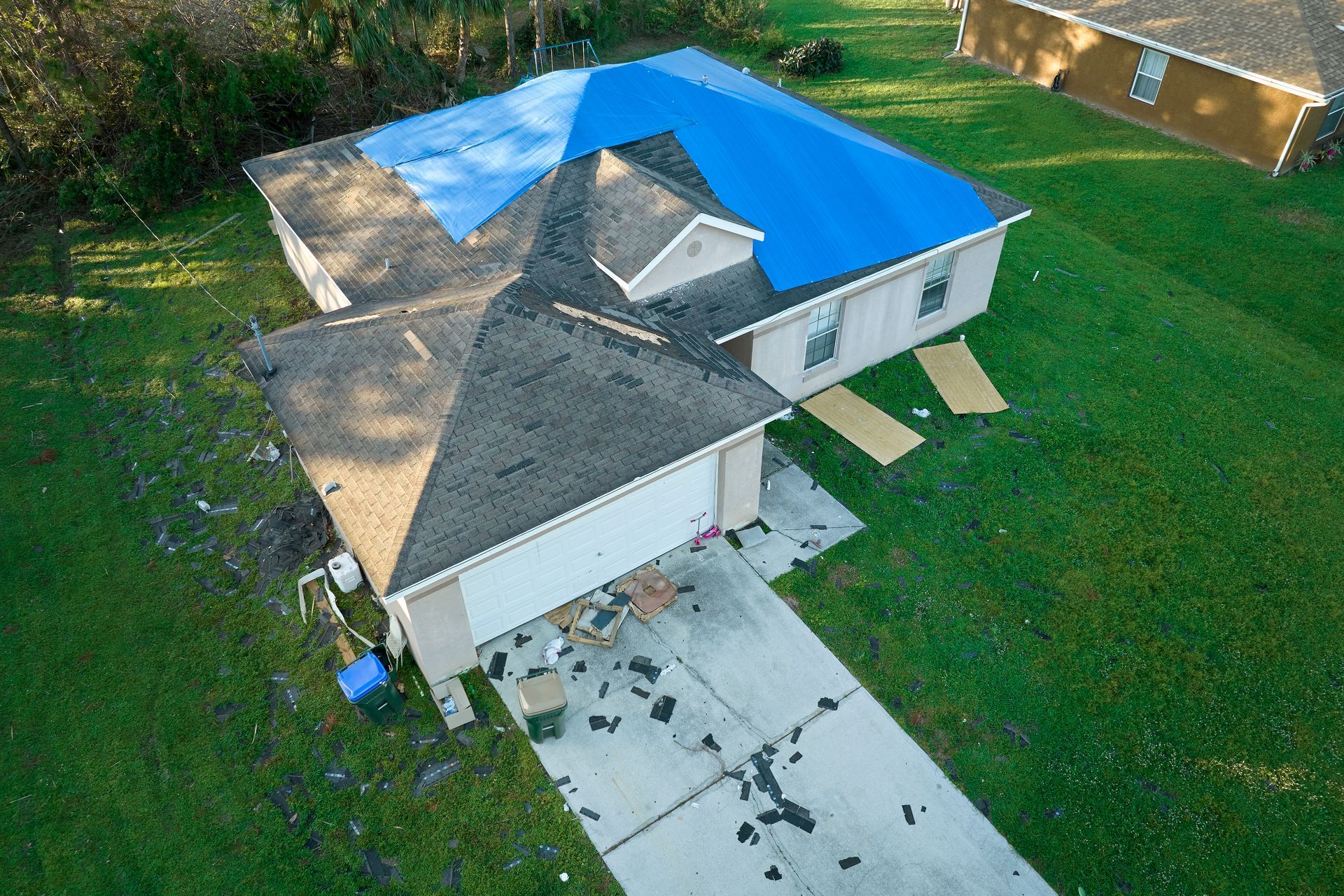
A quick State of the Industry stat block, free of charge: roughly 14,000 people across the U.S. experience water damage every single day, and insurers pay out something like $2.5 billion annually to deal with it. Locally, North Georgia has been racking up repeated severe-storm and flood-watch events through 2026, which means storm-season readiness in Athens is no longer a hypothetical exercise for a slow news day. It is a Tuesday-morning email you might actually get.
Early Leak Detection — Catching It Before the Ceiling Tiles Do
Warning Signs Facility Managers Should Never Ignore
Water is sneaky. It rarely announces itself with a marching band; it prefers to warp a ceiling tile here, leave a musty smell there, and buckle a strip of VCT flooring somewhere you won't notice until Thursday. Watch for warped ceiling tiles, musty odors, unexplained humidity, discolored drywall, buckling floor tile, a suspiciously higher water bill, and condensation collecting on pipes and windows like they're sweating out a secret.
Commercial Leak Detection Tools and Techniques
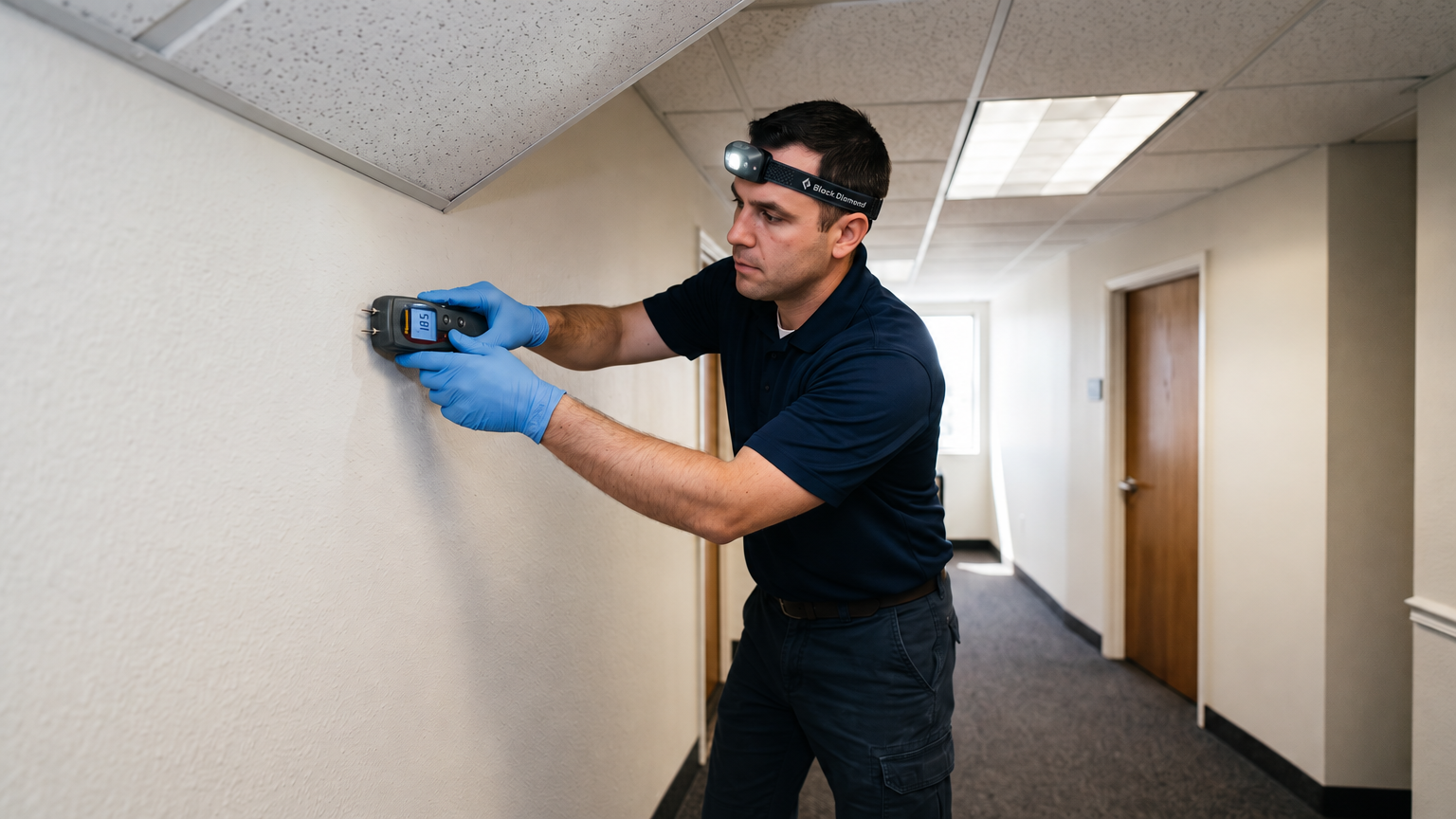
Modern detection isn't a guy with a flashlight anymore, although a guy with a flashlight still helps. Technicians now use thermal imaging, pin and pinless moisture meters, hygrometers, and infrared scanning of walls and ceilings, and they document every single reading digitally, because "I think it felt kind of damp" is not a phrase adjusters enjoy.
Building a Simple Monitoring Routine
Set a monthly walkthrough of mechanical rooms, roof drains, restrooms, kitchen lines, and sprinkler risers, and add an after-hours check any time it rains hard enough to make the parking lot look like a water feature. Here's the part nobody wants to hear: the water you can see is the cheap kind, because somebody fixes it. The water you can't see is the expensive kind, because it just sits there quietly growing a mold colony with its own zip code. Preventive detection costs far less than mitigation, and it keeps your warranty and your insurance standing intact — which is a sentence your insurance agent would frame if agents were allowed to have feelings.
The First 24 Hours — An Hour-by-Hour Commercial Response Plan
Consider this your numbered instruction sheet. Follow it, and you dramatically improve your odds. Ignore it, and you will star in next quarter's insurance case study.
- Hours 0–2, Safety and Shutoff. Kill power to the affected zones, shut off the water source, redirect foot traffic, and photograph everything before a single item gets moved — including, if we're honest, that unfortunate potted plant nobody has watered anyway. Then call a restoration team.
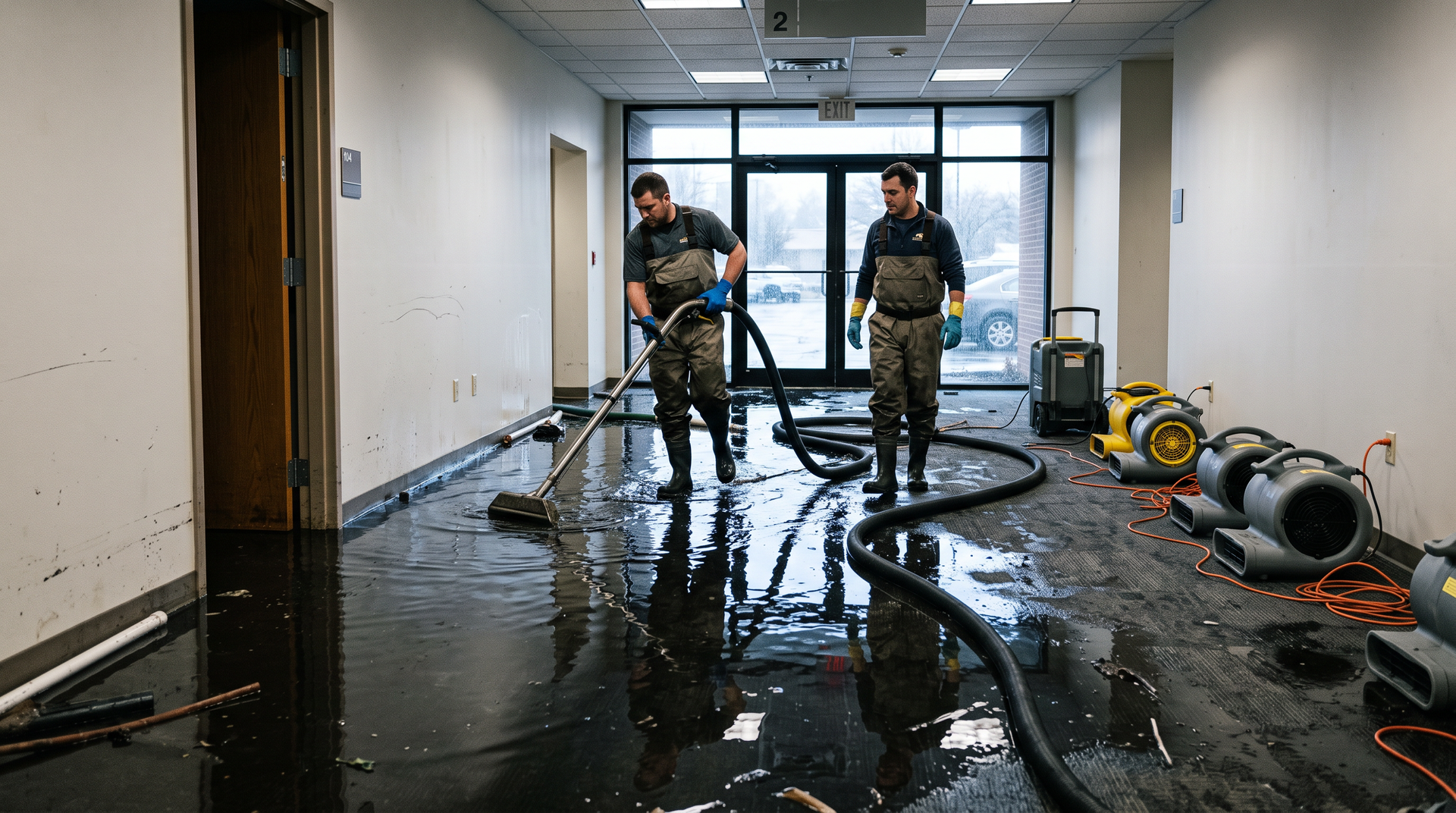
- Hours 2–8, Emergency Water Removal. This is truck-mount and portable extraction, standing-water pumping, wet-vacuuming of carpet and pad, and hauling out anything too far gone to save. Water does not get sentimental about your carpet, and neither should you.
- Hours 8–24, Assessment and Drying Setup. Crews moisture-map the building room by room, write a formal scope of work, photograph and log readings for the insurance file, and position air movers, dehumidifiers, and negative air machines like a very serious, very loud science fair.
Somebody on your team needs to be the single point of contact — one person, one phone, no committee. Notify tenants and staff, and protect the inventory, files, and equipment sitting in the adjacent zones that water hasn't reached yet but is absolutely eyeing.
And here is your short, essential Do-Not list: do not run the HVAC hoping it will "dry things out"; do not leave wet documents stacked in a heap like a paper lasagna; and do not assume a shop vac from the supply closet has heroically solved a commercial-scale flood. It has not. It never does.
Victory RCS provides emergency water removal and water mitigation services across Athens, Winterville, Oconee and Clarke County, and the UGA area, at all hours, because water damage has famously never once checked anyone's business hours.
Structural Drying Science — Why Air Movers and a Dehumidifier Aren't Enough
How Water Actually Moves Through a Commercial Building
Water moves through your building using three forces — gravity, capillary action, and vapor pressure — pulling it steadily into subfloor, framing, and wall cavities like it has somewhere important to be. It does not.
The Drying Equation: Airflow, Temperature, and Dehumidification
Technicians balance airflow, temperature, and dehumidification precisely, with specialty approaches for hardwood, concrete slab, and VCT tile, then take daily moisture readings against a measurable "dry standard" — the actual scientific threshold, not the vibes-based "feels dry to the touch" standard that has ruined more buildings than I can count.
Verifying the Dry Standard
The most common commercial mistake is sealing the building up and running the HVAC full blast, which does not dry anything — it just distributes moisture evenly throughout the building like an unwanted air-conditioned mist, feeding mold in cavities nobody's looking at. Improper drying leads to recurring claims, warped flooring, and long-term air quality complaints, none of which improve morale.
Mold Prevention — Beating the 24–48 Hour Window
Why Mold Starts So Fast in Commercial Buildings
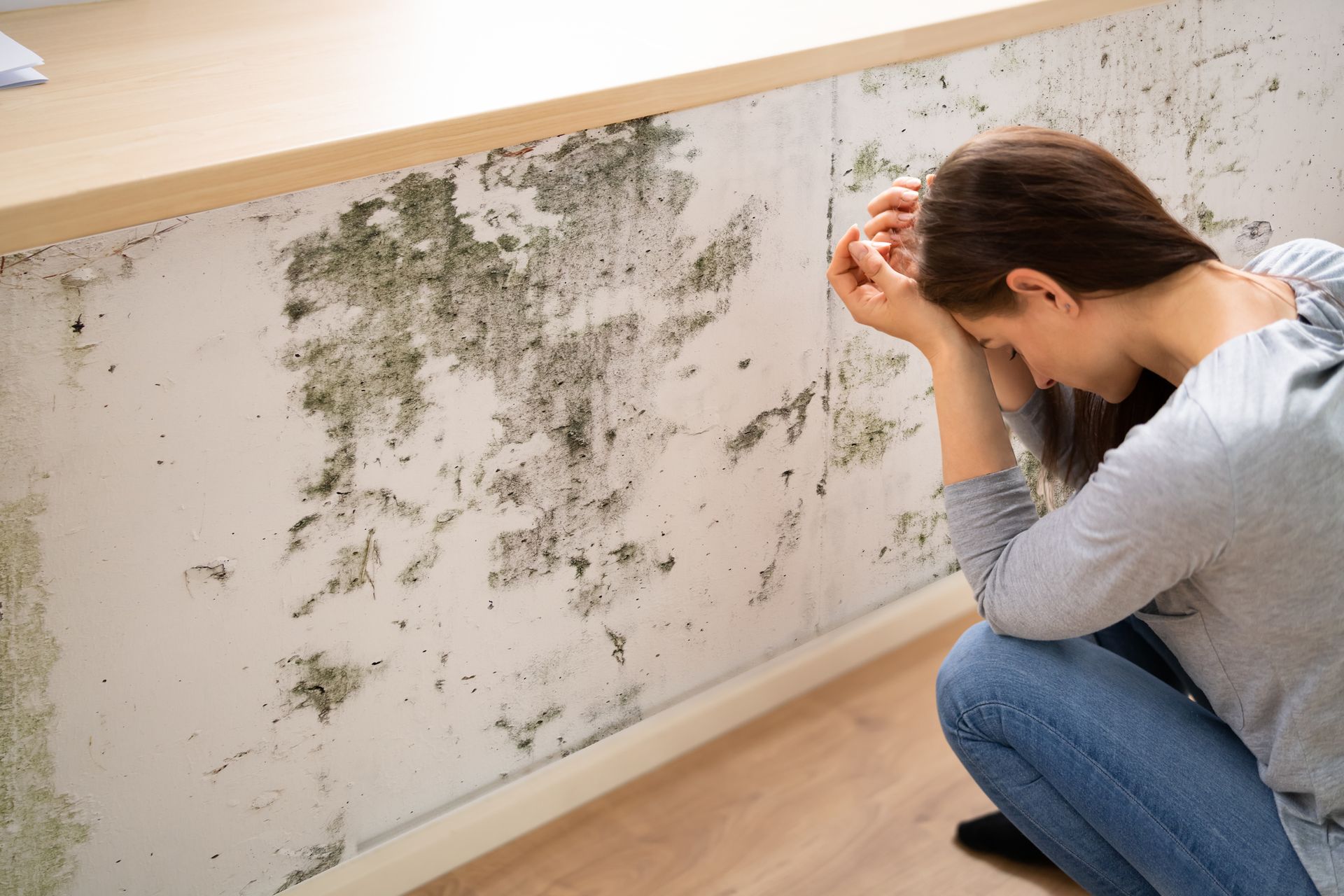
Mold growth can begin within 24 to 48 hours of water exposure. Read that again. That is roughly the amount of time it takes some companies to schedule an internal meeting about scheduling a meeting, and it is exactly why the first day decides far more than the final invoice.
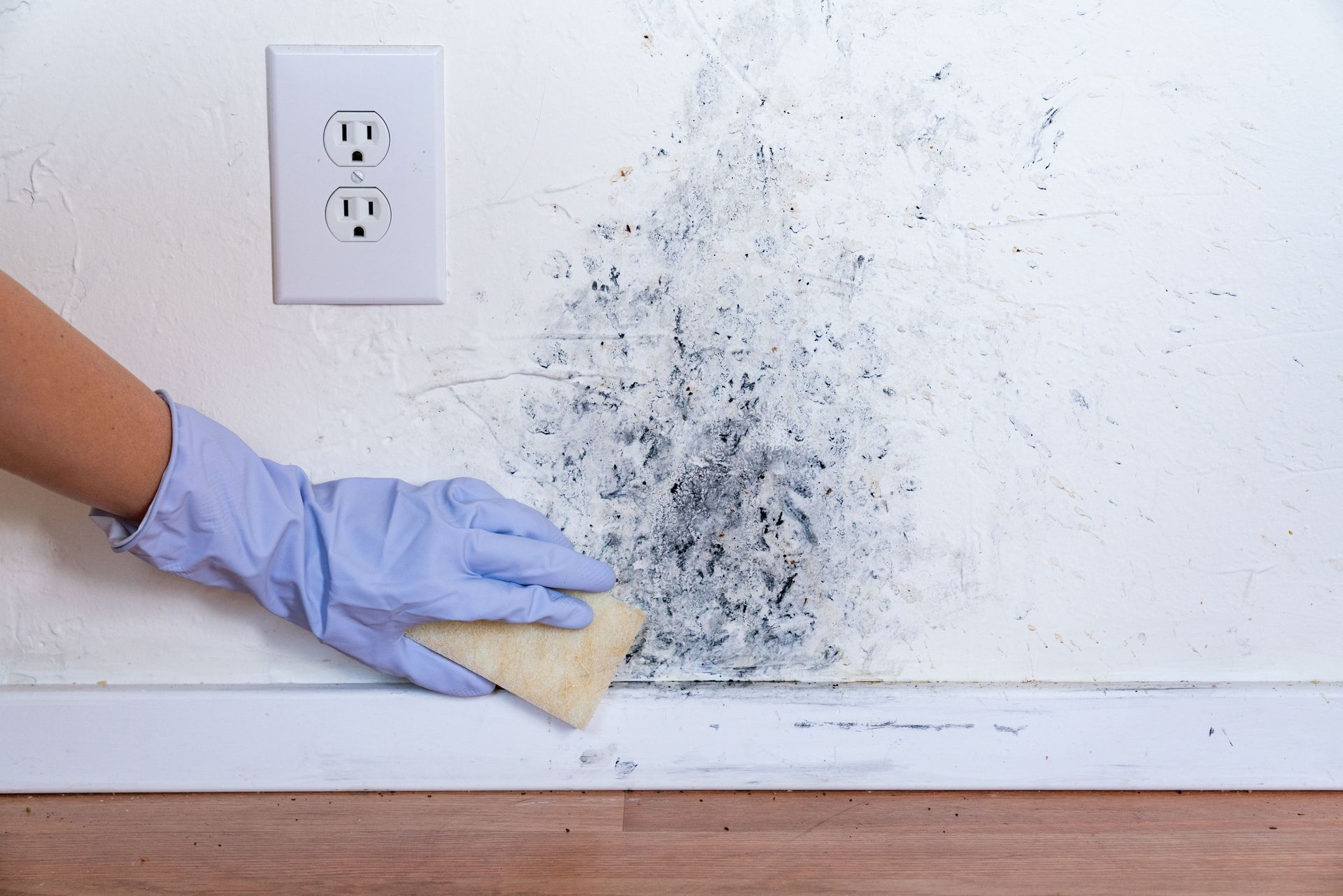
Commercial buildings are basically a luxury resort for mold: large wet surface areas, low airflow behind fixtures and in plenum spaces, warm interior temperatures, and porous materials like ceiling tile, carpet, and drywall practically rolling out the welcome mat.
Containment, HEPA Filtration, and Remediation Basics
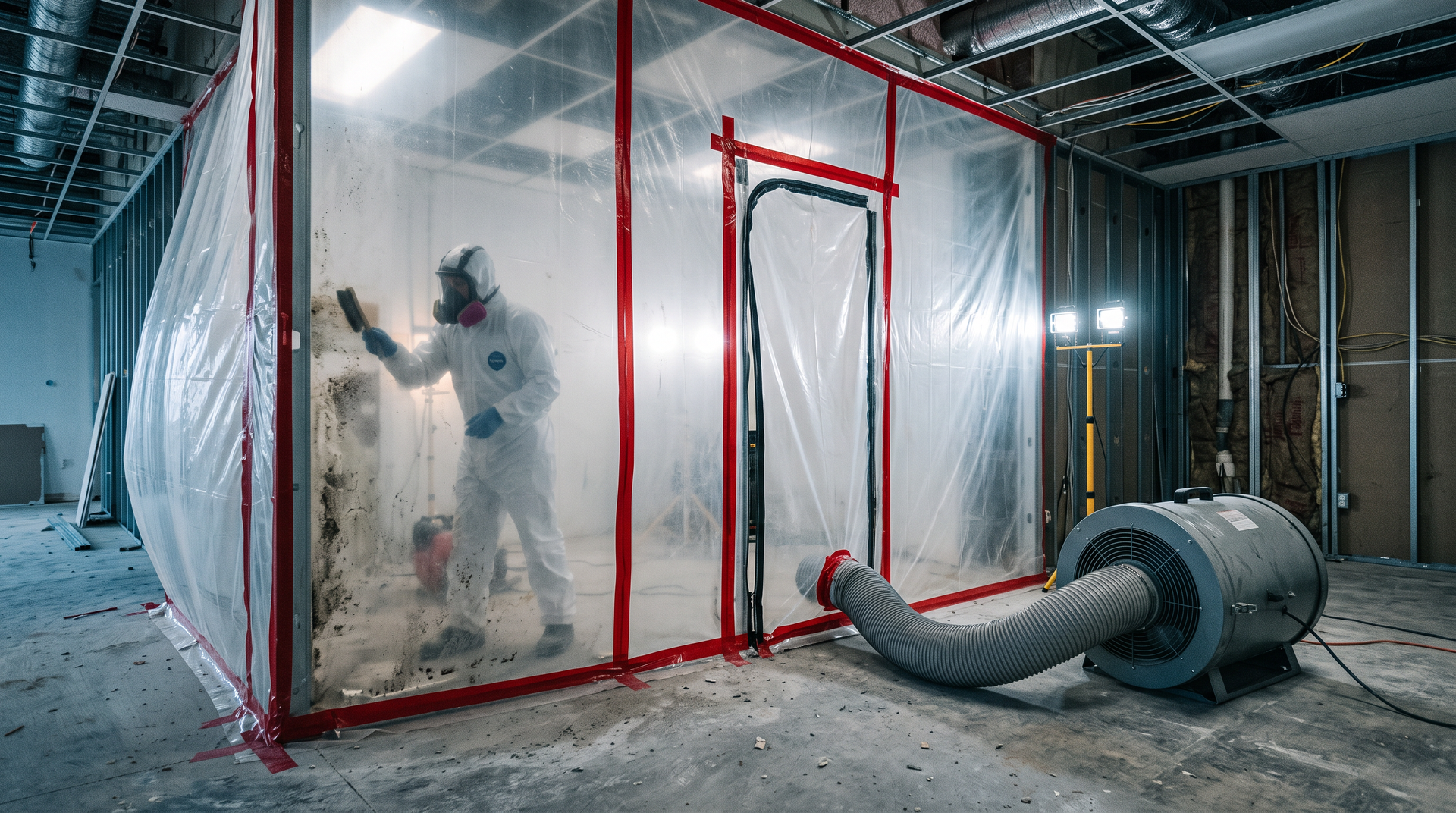
Proper containment means sealed barriers, negative air pressure, HEPA air scrubbers, and protective gear for workers, all working together to keep mold spores from migrating into clean zones. It is not glamorous work. It is, however, considerably more glamorous than explaining a mold outbreak to your regional manager.
How to Prevent Mold After Water Damage in a Commercial Building
The short version: dry everything within 48 hours, control indoor humidity, fix the water source first, replace anything porous that got saturated, and schedule post-remediation verification when needed. Mold remediation in Athens GA is, far too often, the second invoice on a job that could have been just one. Early response doesn't just save money — it prevents the sequel nobody asked for.
Insurance-Integrated Restoration — Documentation That Pays the Claim
What Adjusters Need to See
Adjusters in 2026 do not want your recollection of events. They want timestamped photos, moisture readings by room, daily drying logs, a written scope of work, and material disposal records — a full documentation package, because the industry has shifted firmly toward insurance-integrated service models and digital damage assessment. Carriers expect data now, not a confident guess from memory.
Working Directly With Carriers and Property Managers
Your job as a property manager is simple to state and easy to botch: report the damage promptly, keep your claim reference number handy, document business interruption losses separately, and preserve damaged materials for review whenever possible. Late reporting is, by a wide margin, the single most common way a perfectly legitimate claim gets reduced. Victory RCS documents every job to carrier standards and stays in communication with adjusters throughout, which is the restoration-industry equivalent of showing your work on a math test.
Choosing a Commercial Restoration Partner in Northeast Georgia
Questions to Ask Before You Sign
Before you hire anyone, ask about 24/7 emergency availability, certified technicians, commercial-scale drying equipment, mold remediation capability, insurance documentation experience, and a written scope and pricing. If a company cannot answer these questions clearly, that is itself an answer.
Why Local Response Speed Matters
Here's the local math, and it isn't complicated: a crew based in Athens or Winterville reaches downtown Athens, the UGA area, Oconee County, and Clarke County fast, and travel time is drying time. Every extra mile is another 30 to 100 percent tacked onto your bill, invisibly, while you wait in traffic on the Loop.
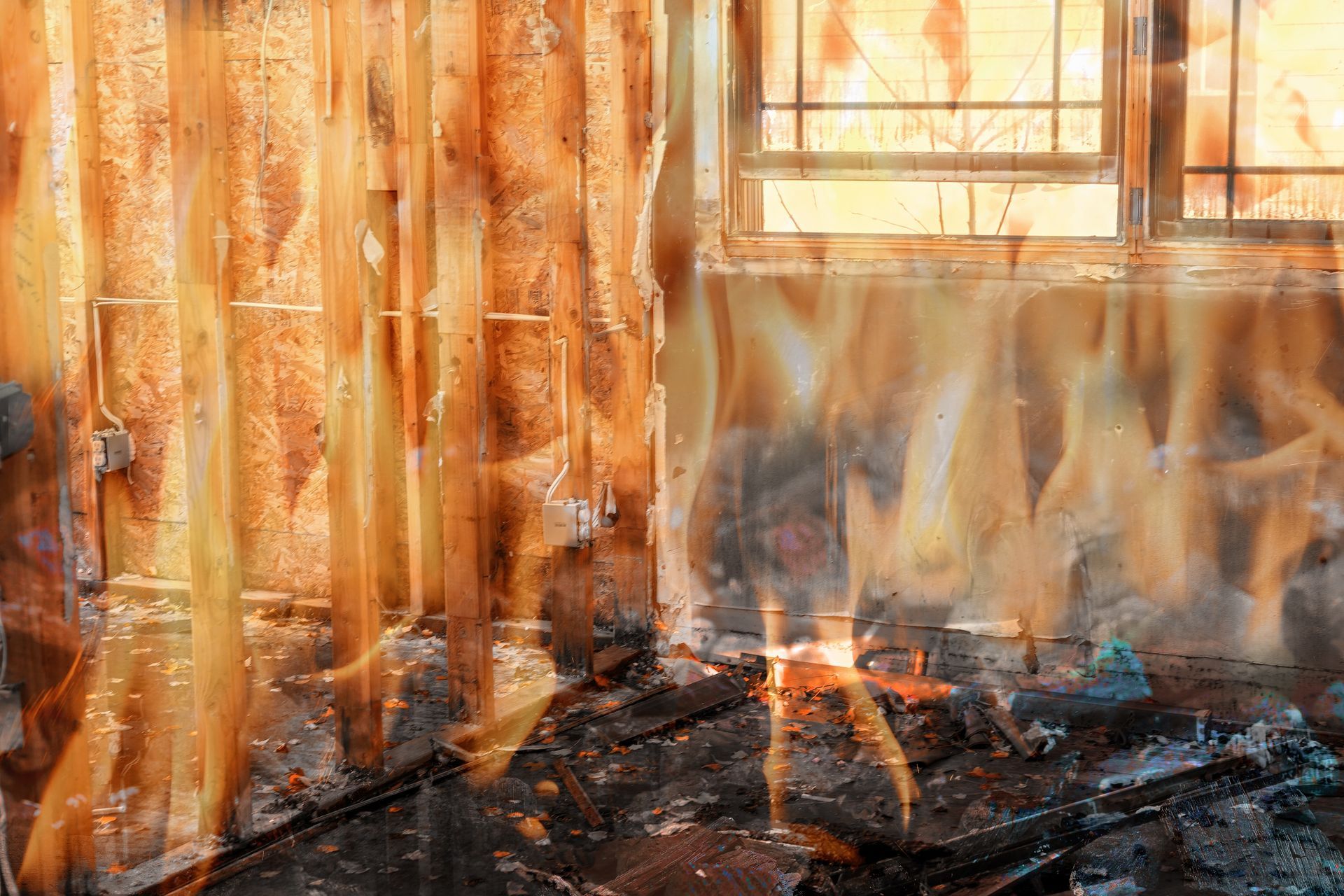
Victory RCS was born from C&C Janitorial Services, carries more than 20 years of experience, and focuses squarely on commercial and B2B clients, with a full service line running from water damage and fire and smoke restoration to carpet cleaning, VCT floor waxing, and tile floor care. One vendor, handling both mitigation and restoration, is the closest thing to a downtime-reduction strategy that doesn't require a consultant.
Don't Let the Second Day Cost You — Contact Victory RCS
Free Commercial Quotes and 24/7 Emergency Response
So, to recap: the first 24 hours decides the cost, the drying outcome, and whether mold gets to crash the project. It really is that simple, and it really is that expensive to ignore.
Call Victory Restoration & Cleaning Service at 706-410-1241 for emergency water removal, structural drying, and mold remediation across Athens and Northeast Georgia. Or request a free quote at www.victoryrcs.com — 102 S. Main St., Winterville, GA 30683.
If you manage a commercial property in Athens, Winterville, Oconee County, or Clarke County, consider scheduling a preventive moisture inspection before storm season arrives. It is the cheapest insurance policy you will never technically call an insurance policy.
The building dries either way. The only question is what it costs you to get there.